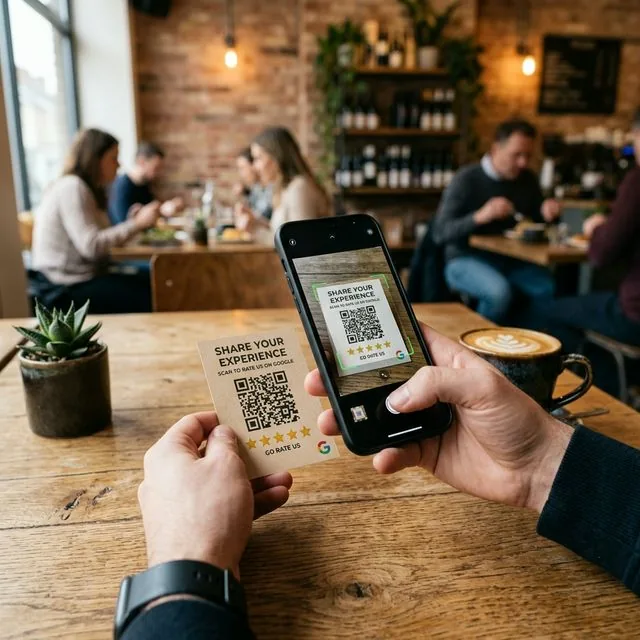
QR Code for Google Reviews: Get More 5 Reviews
Boost your local business growth with QR codes for Google Reviews. Learn how to automate review collection and get more 5-star ratings easily.
Read MoreRead the latest news, updates, and articles about QR Codes, Marketing, and Technology.
Most QR code advice online is written for people who already know what a QR code is. This blog is the opposite. Every guide here starts from the decision you are actually trying to make: should this code be static or dynamic, how big does it need to be printed, where should it go, and what should the person see after they scan it.
We write about the things that go wrong in practice. Codes printed too small for the distance they are read from. A Wi-Fi code left up after the password changed. A review campaign that sends customers to a page requiring a Google login. A menu code that points at a PDF nobody can read on a phone. These are not exotic failures — they are the normal failure modes, and they are all avoidable.
If you are new to QR codes, start with the type that matches your job — a website link, a Wi-Fi network, a digital business card — then come back here for the strategy. If you are comparing tools, our free QR code generator comparison covers price, expiry, export formats and tracking across the main options.
Boost your local business growth with QR codes for Google Reviews. Learn how to automate review collection and get more 5-star ratings easily.
Read More
QR codes are no longer just a trend—they’ve become an essential tool for modern businesses. From marketing to customer engagement, QR codes simplify how brands connect with their audience.
Read MoreYes. The QR code format is open and royalty-free, so anyone can generate and print codes without paying a licence fee. You may still pay for a service that hosts dynamic redirects or provides scan analytics, but creating a static code costs nothing.
Static QR codes never expire because the destination is stored inside the pattern itself. A dynamic QR code works through a redirect controlled by a provider, so it stops working if that subscription lapses. If permanence matters, choose static.
A practical rule is one centimetre of code width for every 10 centimetres of scanning distance. A code read from 30 cm needs about 3 cm; one read across a room needs proportionally more. Always print a physical proof and test it at the real distance.
Only dynamic codes can be tracked, because the scan passes through a redirect the provider controls. Static codes give you no scan data at all. If you need numbers, plan for a dynamic provider before you print.
The scan itself needs no connection when the data is stored in the code, such as plain text or a Wi-Fi password. If the code points at a URL, the page still needs a connection to load.